


Table of Contents
When trying to understand managed services challenges, a morning IT ticket queue tells the story. A new hire waits on Microsoft 365 access, finance needs QuickBooks or invoice systems, remote staff can’t connect before a customer call, and leadership asks why the same tickets keep returning. These aren’t separate help desk annoyances. They’re IT managed services challenges tied to planning, ownership, and risk.
Dmitriy Dvoskin, CTO Advisor at Janus Networks, notes: “The best support teams study repeat tickets like financial data because patterns reveal where access, policy, training, and infrastructure are quietly slowing the business.”
Downtime makes that planning urgent. At the largest scale, unplanned downtime costs the world’s 2,000 biggest companies an estimated 600 billion dollars a year. The better question is how uptime and cybersecurity fit with cloud, licensing, backups, and support governance.
IT Managed Services Challenges That Show Up In Daily Work
Many issues look small until they repeat across teams. A locked laptop, stalled approval, or slow file share becomes a business pattern when no one connects tickets to systems, owners, and restoration steps.
Key examples of this include:
-
Slow ticket resolution: Users wait for access while customer handoffs or lab uploads sit unfinished.
-
Unclear issue ownership: The help desk, network team, and application owner each touch the ticket, but no one owns restoration.
-
Patch delays: Endpoints miss updates, increasing alerts during normal remote work.
-
Cloud cost surprises: A test server keeps running after a project ends, and finance sees the invoice too late.
Once those patterns are visible, the next step is stronger governance across cloud, backup, and licensing decisions.
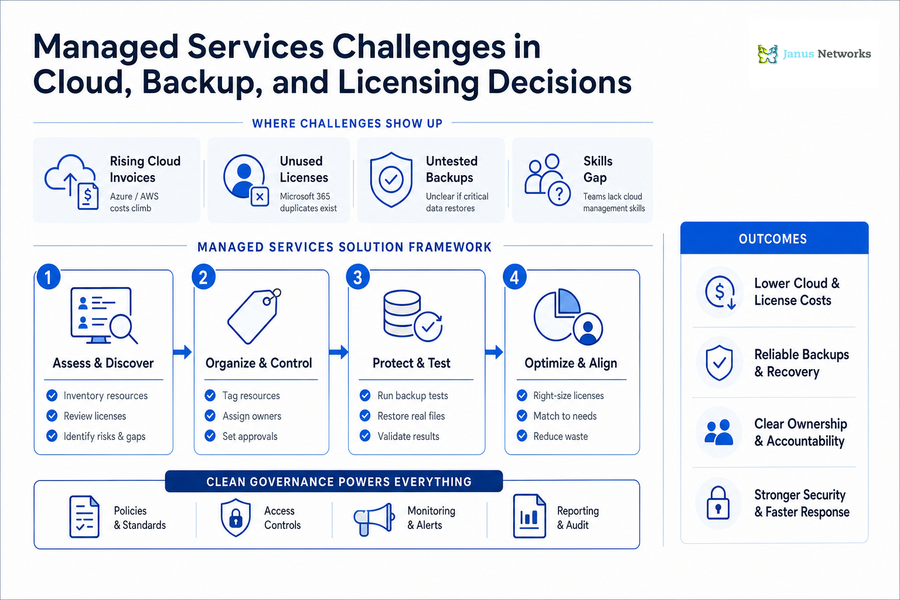
Managed Services Challenges In Cloud, Backup, And Licensing Decisions
Finance sees Azure or AWS invoices rising while duplicated Microsoft 365 licenses sit unused. Backups exist, but no one has tested whether payroll files or clinical records restore cleanly. These managed services challenges become budget and workflow problems when cloud ownership is unclear, and 69% say their team lacks the skills needed to manage cloud applications well.
Examples of this idea are:
-
Microsoft 365 cleanup: Remove duplicate licenses before renewals and align access with job needs.
-
Azure and AWS controls: Tag resources by project, owner, and approval so unused workloads don’t become recurring spend.
-
Backup recovery tests: Restore real files on a schedule so recovery steps are proven before an outage.
-
Licensing cost review: Match users to needed features and tie Windows, cloud, and Microsoft licensing to budget owners.
Clean governance also makes security response easier to coordinate.
IT Managed Services Provider Challenges That Affect Security Response
A suspicious Microsoft 365 sign-in lands at 6:40 a.m. and an endpoint alert follows. IT managed services provider challenges appear when tools, people, and escalation paths are scattered. Delay can lock out remote staff, pause invoice approvals, expose compliance gaps, and pull leaders into avoidable status calls.
What this looks like in practice: A phishing email reaches a shared mailbox, then one user clicks before the rule is updated. Security teams already feel the strain, since 24% of cybersecurity departments faced layoffs in 2024 and 67% said staffing no longer met goals. Complexity adds pressure when organizations manage an average of 83 security solutions from 29 vendors.
Stronger response connects endpoint protection, email security, SIEM monitoring, and firewall rules before the next alert.
Learn More About Managed IT
Managed Services Providers Challenges When Support And Strategy Drift Apart
Day-to-day support loses value when it’s disconnected from budgeting, application plans, infrastructure upgrades, and compliance needs. Managed services providers’ challenges become business issues when support data never reaches planning meetings.
-
Recurring tickets drain staff time. A password reset pattern can point to broken onboarding steps or weak identity rules.
-
Aging infrastructure slows projects. A legacy server can delay a new reporting dashboard, facility upgrade, or remote access rollout.
-
Poor application support delays work. A database error in an order system can stall approvals across sales, finance, and operations.
-
Weak onboarding creates access risk. A rushed new-hire request can grant the wrong mailbox, cloud drive, or business app.
-
No roadmap creates budget surprises. Renewals, audits, and hardware refreshes should be planned before invoices arrive.
Get Ahead Of Recurring IT Issues
If repeat tickets, patch delays, or support gaps are slowing work, Janus Networks can help you plan a steadier managed IT approach.
Managed IT Service Challenges And Practical Next Steps For Stronger Operations
Changing support habits is hard when teams are already busy. Teams can start with visible workflows and make each fix measurable, so support work becomes easier to prioritize and approve. Backup testing is especially important because more than 90 percent of mid-size and large organizations lose over 300,000 dollars for a single hour of downtime.
Key examples of this include:
-
Review ticket patterns: Check top repeat issues each month by user group, system, and root cause.
-
Audit cloud licenses: Compare Microsoft 365, Azure, and AWS usage against active users and approved projects.
-
Test backup recovery: Restore a finance folder, database, or lab file before an incident forces the question.
-
Define alert escalation: Decide who handles suspicious sign-ins, endpoint alerts, and phishing reports after hours.
These steps make the final decision less about buying support and more about building steadier operations.
A Steadier Way To Manage IT Work
Solving managed IT problems takes clear visibility, defined ownership, faster security response, and planning that connects support tickets to budgets. Janus Networks brings over 25 years of hands-on experience across managed IT, cloud, cybersecurity, and Microsoft platforms. Its team also supports application development, onsite support, and 24/7 help desk services.
Organizations facing repeated access, invoice system, remote connection, or security tickets can contact Janus Networks for a Free IT Assessment through the Contact Us page or call sales at (888) 904-1057.