


Table of Contents
Businesses today shouldn’t have to deal with problems caused by poor IT tools. What do IT issues look like day to day? Consider the following: an operations manager starts the morning without access to key documents, a new hire waits on delayed IT onboarding, or a cloud app slows every invoice approval. Nothing is fully down, but work still stalls because no one owns the pattern yet. While those issues may seem small, as they compound, their impact leads to lowered productivity and increased internal frustrations.
One way to end these issues is to work with a managed IT services provider.
Dmitriy Dvoskin, CTO Advisor at Janus Networks, notes: “Managed IT works best when support teams track patterns, not just tickets, because recurring issues usually point to ownership gaps in systems or process.”
Managed IT services means ongoing support for monitoring and maintenance. It also covers security, backup, and infrastructure management under a defined service agreement. That agreement sets who watches systems, who responds to tickets, and how issues escalate. The question of why managed services matter is practical: employees need steady systems and clear support ownership. It’s become a planning priority, with managed services spending rising to 18% of IT budgets in 2023.
Why Use Managed IT Services For Work That Cannot Keep Stopping
Unmanaged IT creates delays even when systems are technically online. A user opens email but can’t reach a shared folder. A remote employee connects to the VPN but can’t access the app needed for a customer handoff. That’s why using managed IT services comes down to assigned ownership and follow-through across users, devices, and networks.
Key examples of this include:
-
Faster ticket resolution: Help desk triage routes password resets, device issues, and access problems to the right queue.
-
Fewer recurring issues: Trend reviews connect repeat tickets to root causes.
-
Smoother onboarding: New hires receive accounts, devices, and permissions before day one.
-
Safer remote access: Endpoint support keeps laptops patched, monitored, and tied to approved controls.
About 55% of companies have approached managed service providers to reduce security risks.
Managed Services Importance In Everyday Business Operations
Operational callout: consistency matters most when several small IT issues hit the same workday.
A hybrid team loses Microsoft 365 access before a proposal deadline. One laptop fails while a client file is due. A cloud invoicing app slows during approval routing, and finance waits for the export.
The importance of managed services shows up in how those issues are handled. Monitoring flags the cloud slowdown, the help desk owns the access ticket, and device support manages replacement steps through a defined process. Clear support channels reduce interruption because ownership is assigned before the next ticket lands. Managed services are now a strategic focus for 99 percent of organizations.
Why Managed IT Services Create Stronger Operating Discipline
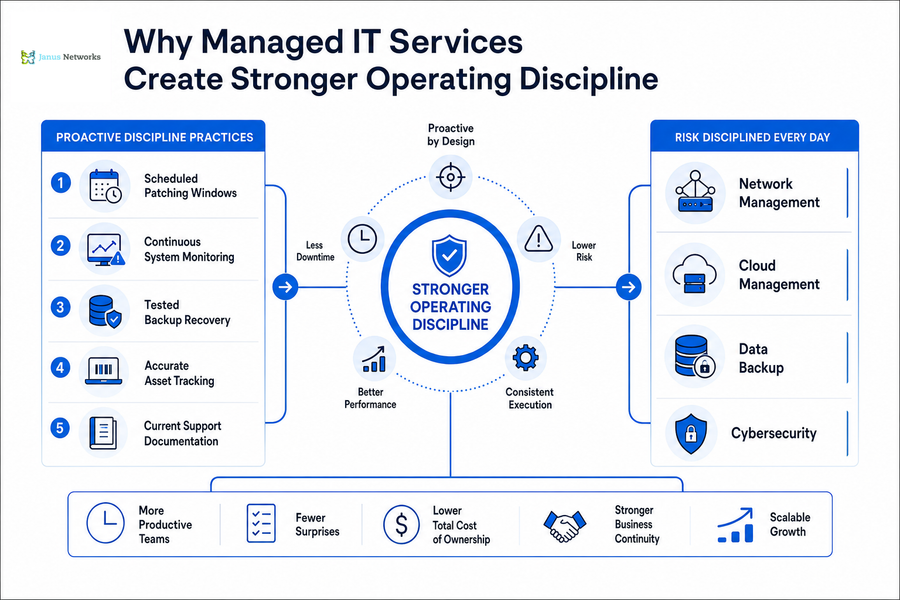
Break-fix support waits for failure. Proactive support builds routines before users lose time. That’s why managed IT services matter when repeat tickets, missed patches, and undocumented fixes create rework.
Examples of this idea are:
-
Scheduled patching windows: Updates happen through approved timing.
-
Continuous system monitoring: Alerts catch capacity, connectivity, and service errors early.
-
Tested backup recovery: Restores are checked before lost data becomes a business delay.
-
Accurate asset tracking: Device records support renewals, warranties, and replacement planning.
-
Current support documentation: Runbooks reduce rework when issues escalate.
These routines turn support from a scramble into a managed operating rhythm. Network management, cloud management, data backup, and cybersecurity improve when teams follow clear routines.
Learn More About Managed IT
IT Managed Services Value Proposition Beyond Lower Support Costs
Cost control matters, but the IT managed services value proposition is stronger when support creates predictable operations, cleaner ownership, and better risk management. Internal teams already carry user tickets, renewals, access approvals, and project deadlines. Organizational change is difficult, so the strongest support models make ownership clearer instead of adding confusion.
Key examples of this include:
-
Access to specialists: Cloud, Microsoft 365, and security experts support complex escalations.
-
Predictable budget planning: Leaders see support scope before invoices arrive.
-
Compliance-ready workflows: Documentation supports approvals, audits, and evidence requests.
-
Stronger risk management: Co-managed IT extends internal teams with cybersecurity support, cloud governance, and strategic planning.
The business case is practical since breach costs reached USD 4.88 million in 2024.
Stop Letting IT Interrupt Work
Turn recurring tickets and access issues into a managed process with Janus Networks. Get clearer ownership for steadier operations.
Why Managed IT Services Are Better For Complex Environments
Managed services fit best when technology has many dependencies. This is why managed IT services are better for dependent environments. One office move or LIMS access change can touch networks, identity, and compliance controls. A cloud migration can also affect endpoints and approvals. Some businesses use fully managed services, while others use co-managed support. The right model depends on where work gets stuck.
Examples of this idea are:
-
Lean IT teams: Keep daily tickets moving while projects continue.
-
Multiple locations: Standardize LAN, WAN, and cloud networking support.
-
Hybrid workforces: Secure remote access across devices and applications.
-
Regulated data: Protect research data, LIMS access, and audit trails.
-
Cloud-heavy or aging environments: Modernize infrastructure before performance or hardware limits growth.
Why Managed Services Providers Should Be Judged By Process Maturity
When payroll stalls or a ransomware alert hits, tool names and hourly rates don’t show how support works. Process maturity shows who responds, how tickets are tracked, and when leaders get clear reporting. That’s why managed services providers should be judged by accountability and documentation. Escalation paths, security practices, and business alignment matter as much as tooling.
Key examples of this include:
-
Clear SLA terms: An SLA states response targets and escalation rules in plain English.
-
Documented escalation paths: Tickets move from help desk to specialists without guesswork.
-
Useful operational reporting: Leaders see trends across users, devices, and systems.
-
Defined security practices: EDR watches endpoints, while MDR adds monitored response.
-
Aligned business reviews: Planning connects risk, budget, and upcoming changes.
Currently, 44% of businesses seek MSPs for cybersecurity capabilities.
A Practical Next Step For Steadier IT Operations
Managed IT services improve daily workflows through fewer interruptions and clearer support ownership. They also support safer access, better documentation, and more predictable planning. Janus Networks is a practical example of a long-term IT partner with experience across managed IT; cybersecurity; cloud; onsite support; strategic technology planning; help desk; Azure and AWS; Microsoft 365; cloud networking; application development; colocation; VoIP; and biotech IT. Organizations reviewing recurring tickets or cloud concerns can contact Janus Networks to talk through cybersecurity risk and support gaps before they become operational delays.